
Last Updated: October 25, 2026
Quick Summary
The best AI marketing tools for franchises are the ones your locations actually open, because features matter less than the speed from login to finished asset. Adoption is the deciding factor: a tool nobody uses protects no brand and wins no customers.
- We scored each category on adoption speed, brand control, franchise fit, and network-wide cost.
- ClickSling charges no per-user, training, or implementation fees across the network.
- Tiered approval workflows auto-approve low-risk localizations and route higher-risk changes to reviewers.
- The adoption test for any DAM: a franchisee finds an approved logo and offer template in under two minutes.
- Consolidation beats features when scheduling lives in a separate tool from asset creation.
Table of Contents
- Why AI Marketing Tools for Franchises Fail Without Local Adoption
- How We Evaluated These AI Marketing Tools
- 1. ClickSling: AI Creative Team With Built-In Brand Control
- 2. Franchise Marketing Software: What Corporate Teams Need
- 3. The Franchise Marketing Portal: More features doesn’t translate into more usage and adoption
- 4. Digital Asset Management for Franchises: Guardrails That Don't Slow Anyone Down
- 5. AI Ad Creative Tools: From Blank Page to Local Campaign in Minutes
- 6. Social Scheduling and Email Automation: Keeping Local Channels Active
- Bottom Line on AI Marketing Tools for Franchises
- Frequently Asked Questions
Why AI Marketing Tools for Franchises Fail Without Local Adoption
Most AI marketing tools for franchises fail for one reason: the people running your locations never actually use them. That's the uncomfortable truth we've learned watching multi-location brands roll out marketing software. A platform only works when a busy franchisee can open it and produce something usable before their next customer walks in.
This guide from ClickSling breaks down seven categories of AI marketing tools for franchises, what each does well, and where the adoption risk hides. For a deeper system on keeping every location on brand, see our 7-step guide to franchise marketing on brand.
How We Evaluated These AI Marketing Tools
We scored each category on four things: how fast a non-marketer gets to a finished asset, how much brand control corporate keeps, how well it fits a franchise network, and what it costs to run across every location. Adoption speed carried the most weight.
A tool that produces beautiful work but requires a designer to operate it is a liability in a franchise system. The best AI marketing tools for franchises are the ones a local manager can use without a support ticket.
Category | Best For | Adoption Risk | Brand Control |
|---|---|---|---|
AI creative platform | Networks wanting speed and control together | Low | High |
Franchise marketing software | Corporate teams managing many locations | Medium | High |
Marketing portal | Centralizing access and assets | Medium | Medium |
Digital asset management | Large libraries and rights control | High | High |
AI ad creative tools | Fast local campaign production | Low | Medium |
Social and email automation | Keeping local channels active | Medium | Medium |
1. ClickSling: AI Creative Team With Built-In Brand Control
ClickSling is an AI-powered marketing and creative platform that gives every location a working creative team without hiring one.
For franchise networks, the appeal is simple. Corporate locks the brand standards, and local operators generate professional work inside those guardrails. No design skills, no training program, no per-user fees. That last point matters when you're licensing software across dozens of locations.
Where ClickSling Wins for Franchise Networks
The platform combines creative generation with brand asset management, so approved logos, colors, and messaging live in the same place where local teams build campaigns. A franchisee can customize an offer without breaking the brand.
- Fast adoption: no design or marketing background required
- Brand consistency: corporate standards built into every asset
- No per-user, training, or implementation fees across the network
Curious who's behind the AI? Meet the creative team modeled on ad veterans.
What to Know Before You Commit
It's a creative and brand platform, not a full CRM or analytics suite. If you need deep attribution reporting, plan to connect it to your existing stack. A 30-day free trial with no credit card makes the adoption test easy: hand it to three franchisees and see what they produce in week one.
Best for: networks that want local speed without losing brand control. Skip if: you only need a static asset library with no creative production.
2. Franchise Marketing Software: What Corporate Teams Need
Franchise marketing software is the layer corporate uses to distribute campaigns, manage approvals, and see what locations are doing. The strongest platforms let corporate push a campaign once and let franchisees localize it in a few clicks. The weakest add approval steps that stall a local manager for days. If you want to see how a lighter approach works, explore franchise marketing software without the DAM complexity.
The Governance Layer That Actually Matters
Brand governance is where franchise marketing software earns its keep, or loses it. A workable setup has four parts:
- Locked brand assets: logos, fonts, color codes, and approved photography that local users can select but not alter.
- Editable local fields: offer text, address, phone number, hours, and local imagery that franchisees fill in without touching the brand frame.
- Tiered approval workflows: low-risk localizations (swapping an offer date) auto-approve; higher-risk changes (new claims, new imagery) route to a brand reviewer. The mistake is routing everything through the same queue.
Integrations to Check Before You Sign
Franchise marketing software rarely lives alone. Before committing, confirm the platform connects to the systems your network already runs:
- Franchise CRM and lead-routing tools, so local campaign leads land in the right pipeline.
- Point-of-sale and booking systems, so a promotion can be tied to redemptions and revenue.
- Location data and local listings management, so hours, addresses, and store pages stay accurate across the network.
A platform that duplicates your stack instead of connecting to it adds work for local managers, and work is the enemy of adoption.
Measuring Location Performance
Corporate teams need to compare locations on more than impressions. The useful metrics are leads, calls, bookings, conversions, cost per lead, and revenue attribution by location. Ask any vendor how their reporting handles multi-location rollups and whether a franchisee can see their own numbers without filing a support ticket.
Best for: corporate teams managing many locations who need governance, integrations, and location-level reporting in one place. Skip if: you only need a static asset library with no campaign distribution or measurement.
3. The Franchise Marketing Portal: More features doesn’t translate into more usage and adoption
A franchise marketing portal is a single online hub where locations find approved assets, order materials, and launch campaigns. Its whole job is removing friction. Portals fail when they become a filing cabinet nobody visits. The fix is putting creation tools next to the assets, so a franchisee who logs in to grab a logo can also build a local ad in the same session.
4. Digital Asset Management for Franchises: Guardrails That Don't Slow Anyone Down
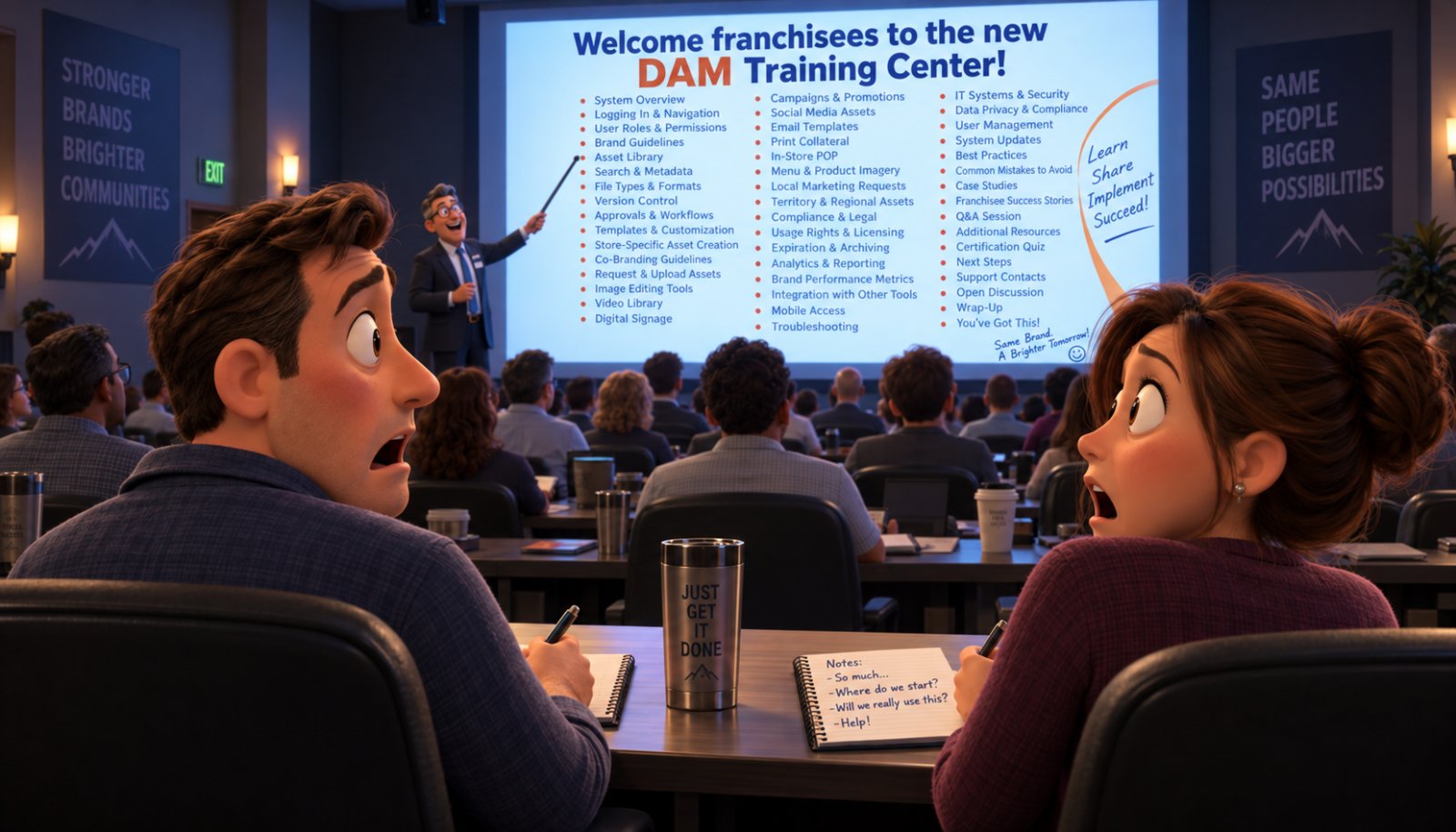
Digital asset management for franchises keeps logos, photography, video, and approved copy organized with the right usage rights attached. It's essential once a network has hundreds of assets and multiple campaigns running, and it is also where adoption most often dies.
The trade-off is complexity. Full DAM systems can take real setup and ongoing admin, which is a lot to ask of a small marketing team. If you're weighing it, read whether you really need a DAM.
Why DAM Adoption Fails at the Local Level
A DAM only protects the brand if franchisees actually open it. The common failure pattern looks like this: corporate spends months tagging and organizing thousands of assets, launches the library with a training webinar, and then watches local teams keep pulling logos from a shared drive or a phone photo of a printed sign.
The root cause is almost always ease of use. If finding the right asset takes more than a minute, wrong filters, unclear naming, no search that understands plain language, a busy local manager gives up. If downloading an asset requires a permission request, they give up faster.
The Guardrails That Don't Slow Anyone Down
The DAM features that matter for a franchise network are the ones that combine control with speed:
- Locked brand assets: logos, fonts, and approved photography that can be downloaded and used but not altered.
- Editable local fields: templates where the brand frame is fixed and the local offer, address, and phone number are fillable.
- Plain-language search and clear naming: so a non-marketer can find "summer promo social post" without knowing the folder taxonomy.
Where DAM Ends and Creation Begins
The strongest franchise setups put creation tools next to the assets. A franchisee who logs in to grab a logo can build a local ad in the same session, inside the brand guardrails, without exporting a file to another tool.
Best for: large networks with hundreds of assets, multiple campaigns, and real rights-management needs. Skip if: your library is small and a simpler platform with built-in asset management already covers what you need.
5. AI Ad Creative Tools: From Blank Page to Local Campaign in Minutes
AI ad creative tools generate copy, images, and video variations from a short brief. For a franchisee with no designer, that's the difference between running a promotion and skipping it.
The risk is generic output that ignores brand rules. Choose tools that start from your brand standards rather than a blank prompt. For a practical walkthrough, see how to create professional ads without a designer.
6. Social Scheduling and Email Automation: Keeping Local Channels Active
Scheduling and email automation keep local channels from going quiet between campaigns. Corporate sets the cadence and approved content; locations add local offers and send.
The adoption lesson repeats here. If scheduling lives in a separate tool from asset creation, local teams drop one of them. Consolidation beats features.
Bottom Line on AI Marketing Tools for Franchises
The best AI marketing tools for franchises are the ones your locations actually open. Features matter less than the speed from login to finished asset, because a tool nobody uses protects no brand and wins no customers.
That's the problem ClickSling was built to solve: an AI creative team, built-in brand asset management, corporate control across every location, and no per-user or training fees.
Frequently Asked Questions
What are the best AI marketing tools for franchises in 2026?
The best fit depends on your network's biggest bottleneck. If brand consistency across locations is the priority, look for AI marketing tools with built-in digital asset management and corporate-approved templates. If local speed is the issue, prioritize platforms with no-training-required creative generation. ClickSling combines both: an AI creative team, brand asset management, and a franchise marketing portal in one subscription, with a free 30-day trial and no per-user fees.
How can a franchise marketing portal make it easier for franchisees to use corporate materials?
A franchise marketing portal removes the friction that kills adoption. Instead of digging through shared drives or emailing corporate for approvals, franchisees log in, pick a brand-approved template, customize local details like address and offer, and publish. The best portals require no design skills and no training session. When the portal is simple, adoption rises, and corporate sees consistent branding across every location rather than a patchwork of improvised posts.
Can AI ad creative tools keep local advertising on brand?
Yes, when the tool enforces guardrails. AI ad creative tools should lock logos, fonts, and color palettes while allowing franchisees to swap in local offers, photos, and contact details. That balance lets a local operator speak to their market without breaking corporate guidelines. Look for a platform with digital asset management for franchises built in, so approved assets are the only options available and off-brand creative never reaches the public.
How do franchises measure adoption of marketing tools across locations?
Track logins, assets downloaded, campaigns published, and local spend per location. A franchise marketing software dashboard should show which locations are active and which are dormant, so corporate can offer targeted help rather than blanket reminders. Pair usage data with campaign results like engagement and conversion rate to see whether adoption is translating into performance. If a location never logs in, the tool is too complex, and simplicity is the fix.
Your network's brand is only as consistent as your least-engaged location. ClickSling gives corporate teams brand control and gives local operators a creative team they can use on day one, with AI agents trained by ad veterans, full video production, and no per-user or implementation fees. Get started with ClickSling and put professional creative in every location's hands.
