
Last Updated: October 24, 2026
Quick Summary
Keep franchise marketing on brand by giving local teams editable templates with locked brand elements, a tiered approval workflow with published turnaround targets, and a monthly five-metric consistency scorecard. Brand integrity holds when the compliant path is also the fastest path, so every rule, template, and tool should make doing it right easier than doing it wrong.
- Only 69% of franchisors were confident their franchisees stay on-brand, per Marvia's 2026 insights.
- Build one template per recurring need; ten focused templates beat a hundred generic ones.
- Pre-approved templates with only text fields open should publish automatically with no human review.
- Every rejection should name the specific rule broken and the fix required.
- Score each location monthly on five metrics and review regionally, not just network-wide.
Table of Contents
- Why Franchise Marketing Drifts Off Brand (and What It Costs)
- 1: Write Franchise Brand Guidelines Local Teams Can Follow
- It might look good on paper, but what about implementation?
- 2: Build Franchise Marketing Templates With Guardrails
- These are the elements that most systems give local franchisees the ability to edit, but do they? Not as much as you might think.
- Step 3: Set a Brand-Compliance Approval Workflow
- Step 4: Show Local Franchise Marketing Examples That Work
- 5: Choose Franchise Marketing Tools That Drive Adoption
- Step 6: Measure Brand Consistency Across Locations
- 7: Govern for Local Flexibility Without Losing Brand Integrity
- Frequently Asked Questions
Why Franchise Marketing Drifts Off Brand (and What It Costs)
Franchise marketing is the practice of coordinating national brand strategy with local execution across independently owned locations. According to Marvia's Franchise Marketing Insights 2026, only 69% of franchisors said they were confident their franchisees stay on-brand.
Here is the costly part. The same survey found that 56% of franchisor marketing teams spend six or more hours per week adapting existing assets (The hidden cost of franchisees going off-script: time, budget, and brand equity).
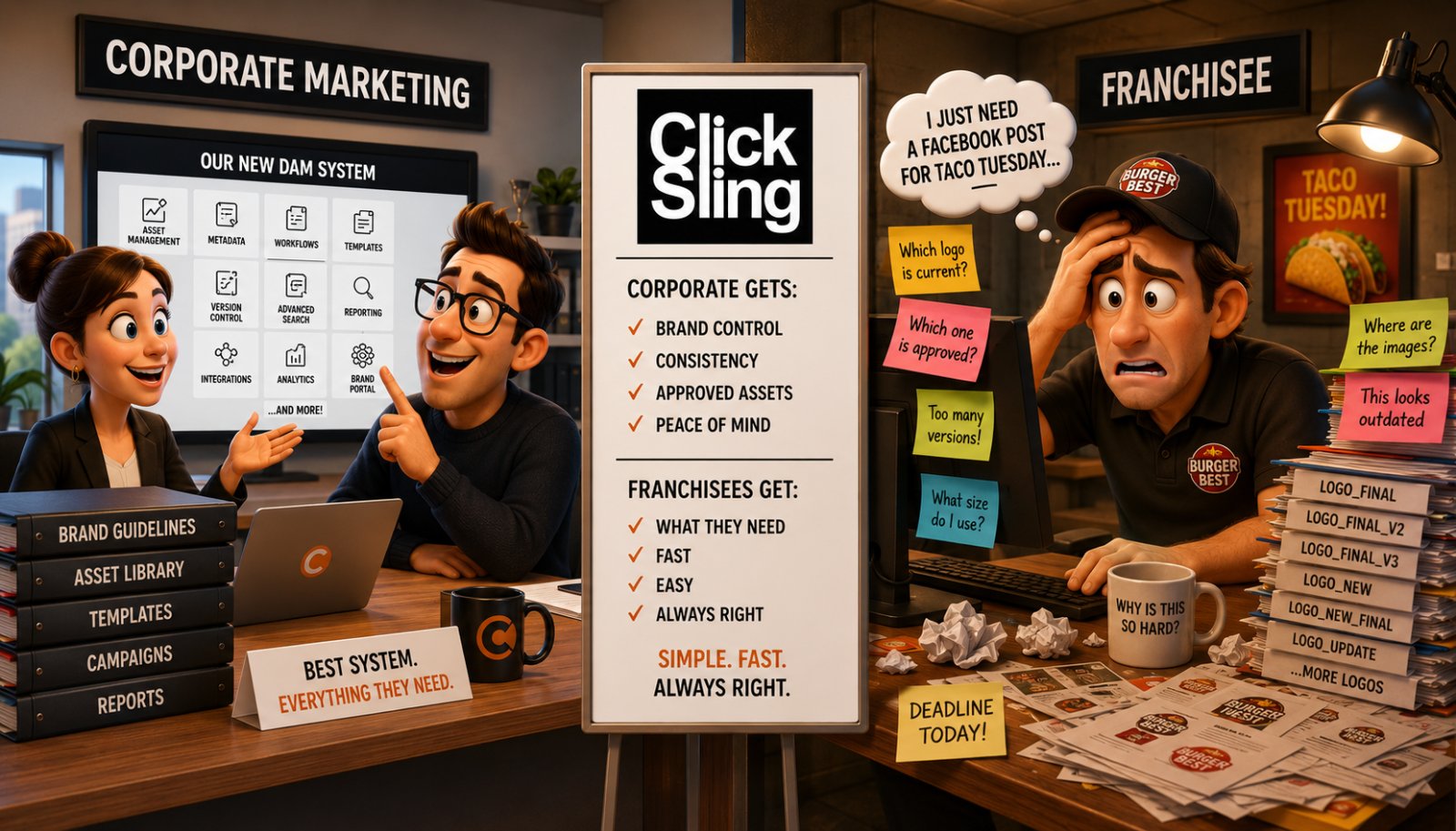
Brand drift rarely starts with rebellion. It starts with friction:
- Guidelines live in a PDF nobody opens
- Templates are locked in formats local teams cannot edit
- Approval takes three days for a Facebook post
This guide from ClickSling walks through seven steps to keep franchise marketing on brand without slowing local teams down. We built our platform on a simple premise: systems that are easy to use get used.
1: Write Franchise Brand Guidelines Local Teams Can Follow
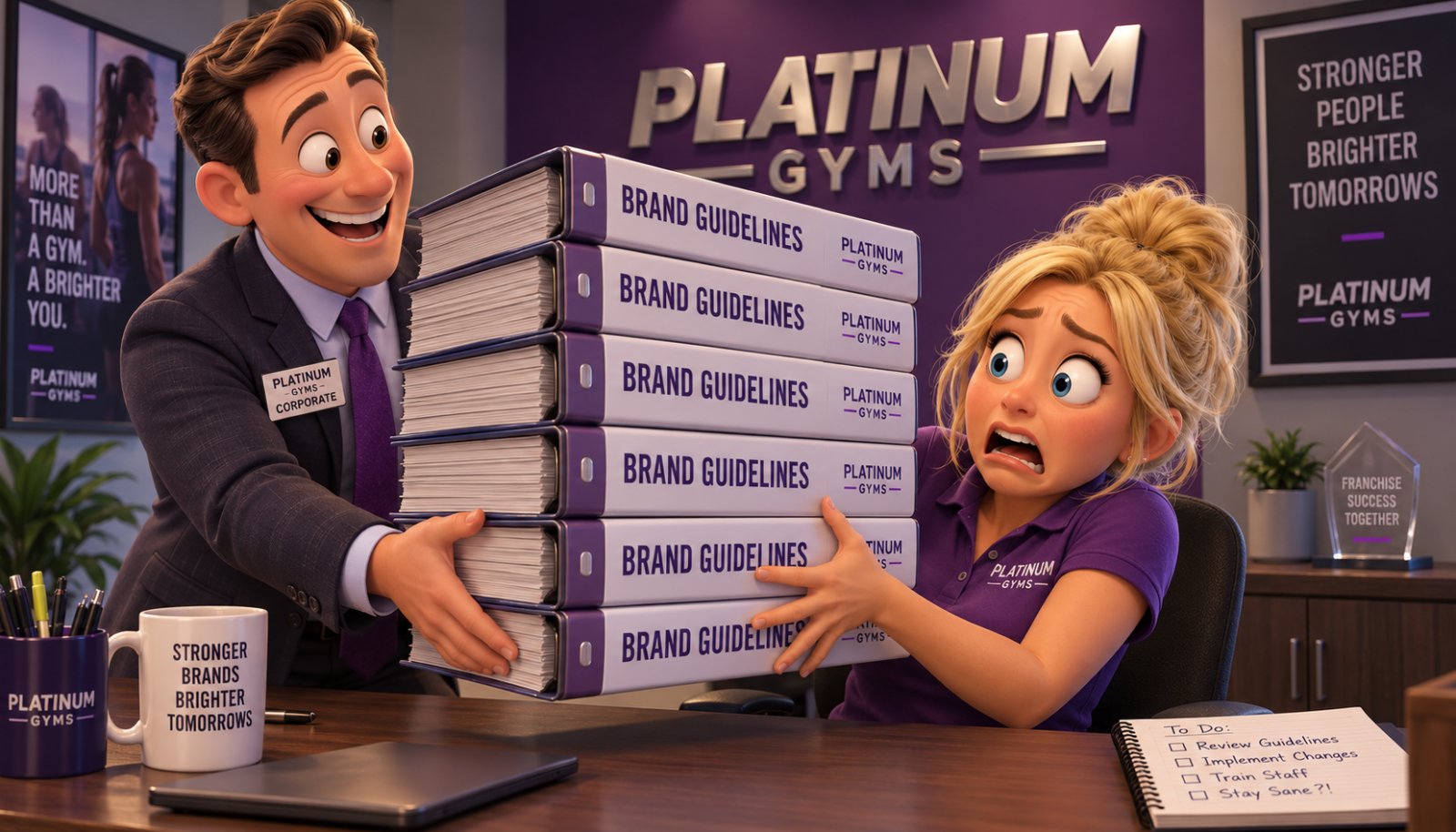
Most franchise brand guidelines fail because they are written for designers, not for the person running a location. A guideline document works when a busy manager can open it, find the answer in under a minute, and get back to work.
What Belongs in the Guidelines
Keep the document short and visual. Cover these sections:
- Logo use: approved versions, clear space, minimum size
- Color palette: exact codes plus a plain-language note on where each color belongs
- Typography: approved fonts and fallback options
- Installations: The ability to translate accurate instructions
That last section matters most. SmartBug Media notes that balancing brand consistency with local individuality is a persistent challenge for franchise networks. Write the rules for local adaptation into the guidelines rather than leaving them implied.
If you want a reference point for how brand standards get documented and enforced in practice, the ClickSling FAQ covers how brand standards work for multi-location brands.
It might look good on paper, but what about implementation?
2: Build Franchise Marketing Templates With Guardrails
Locked files create workarounds. When a franchisee cannot edit a template, they build their own version in a consumer design tool, and the brand starts to slip.
These are the elements that most systems give local franchisees the ability to edit, but do they? Not as much as you might think.
Element | Locked | Editable |
|---|---|---|
Logo and placement | Yes | No |
Color palette | Yes | No |
Headline structure | Style locked | Wording open |
Photography | Approved library | Local photos with review |
Offer and pricing | No | Yes |
Contact details | No | Yes |
Build one template per recurring need: grand opening, seasonal promotion, hiring, local event, review request. Ten focused templates beat a hundred generic ones.
Step 3: Set a Brand-Compliance Approval Workflow
Approval workflows fail in two directions. Too strict, and local teams stop submitting. Too loose, and nothing gets checked. The fix is not a better review meeting, it is a documented workflow with named owners, target turnaround times, and a clear escalation path so no request disappears into an inbox.
Tier the Reviews
A workable franchise approval workflow runs on three tiers:
- Pre-approved: locked templates with only text fields open. No human review needed. The system publishes automatically.
- Light review: logo, color, and required disclaimers checked against the brand rules. Target a same-business-day turnaround.
- Full review: new creative, local partnerships, co-branded promotions, or anything with legal exposure. Corporate sign-off required, with a stated target of two business days.
Most local marketing should never touch a human reviewer, because most of it is already compliant by design. The tier system is the whole point.
Map the Workflow End to End
Write the workflow down so every location sees the same path:
- Brief: the franchisee picks a template or submits a request form that captures the campaign goal, offer, dates, and any local claims.
- Build: the franchisee edits only the open fields; locked brand elements stay fixed.
- Auto-check: the system flags missing disclaimers, off-palette colors, low-resolution images, and unapproved logos before a person ever sees it.
Set Turnaround Targets and Escalation Paths
Publish the service-level targets so franchisees know what to expect:
Tier | Reviewer | Target Turnaround | Escalation If Missed |
|---|---|---|---|
Pre-approved | None (automated) | Immediate | None needed |
Light review | Regional marketing lead | Same business day | Regional director after one business day |
Full review | Corporate brand and legal | Two business days | Brand director after three business days |
A named escalation path beats an email chain every time. When a request stalls, the franchisee should know exactly who to contact and what happens next, not whether to send a follow-up.
Handle Rejections Without Killing Adoption
Every rejection should include the specific rule that was broken and the fix required. A rejection that says "off brand" teaches nothing; one that says "the logo is below the minimum size on page 4 of the guidelines, resize to the approved version in the template" gets the next submission right.
For a closer look at how corporate teams push approved resources to every location, see how multi-location marketing software delivers approved marketing.
Step 4: Show Local Franchise Marketing Examples That Work
Franchisees copy what they can see. If the only examples in your system are national campaigns, local teams will assume local marketing is not allowed.
Build a library of strong local franchise marketing examples:
- A location that ran a compliant grand-opening campaign and what it produced
- A franchisee who localized a national offer for a regional audience
- A market that used approved photography to promote a local event
Label each example with what made it work and which template it came from. Then rotate the library quarterly so it does not go stale. Recognition matters too: featuring a franchisee's work in the corporate newsletter does more for adoption than another compliance memo.
5: Choose Franchise Marketing Tools That Drive Adoption
The best franchise marketing tools are the ones local teams actually open. Complexity kills adoption, and low adoption kills brand consistency. It really is that direct.
When you evaluate franchise marketing tools, score them on these criteria:
Criterion | What to Check |
|---|---|
Time to first asset | Can a new user produce something in one session? |
Training required | Hours of onboarding, or minutes? |
Per-user cost | Does cost scale with every location? |
Brand controls | Can corporate lock what matters? |
Local flexibility | Can franchisees edit what should vary? |
Asset management | Are approved assets easy to find? |
This is where ClickSling was built to fit. Our franchise marketing software gives franchisees fast access to corporate-approved marketing without the complexity of a traditional DAM. There are no per-user, training, or implementation fees, and no design skills required.
Step 6: Measure Brand Consistency Across Locations
You cannot manage what you do not check. Brand consistency measurement turns a vague goal into a number your team can act on. The mistake most networks make is tracking too many things and acting on none of them. A short scorecard, reviewed on a fixed cadence, beats a sprawling dashboard nobody reads.
Build a Five-Metric Scorecard
Score each location monthly on five metrics, each on a simple scale so the results are comparable across the network:
Metric | What It Measures | How to Score |
|---|---|---|
Asset compliance | Share of published local creative built from approved templates | Percentage of campaigns from the library |
Listing accuracy | Name, address, hours, and contact details correct across directories | Pass or fail per listing, rolled up to a percentage |
Campaign adoption | Share of national campaigns the location actually ran | Percentage of eligible campaigns activated |
Approval time | Median turnaround from submission to publish, by tier | Days, compared to the published target |
Local engagement | Response rate and review score on local channels | Trend versus the location's own prior quarter |
Five metrics is enough to see the pattern. Adding more dilutes attention and slows the review.
Set Targets and Review Cadence
Publish a target for each metric and review the scorecard monthly at the regional level, quarterly at the network level. A common pattern is to set the asset-compliance target high, most networks aim for the large majority of local creative to come from approved templates, while treating approval time as a service commitment the corporate team owns, not the franchisee.
Read the Scorecard by Region, Not Just Network-Wide
A strong network average can hide a struggling region. Break the numbers down by region and by location so the pattern is visible:
- A location with repeated compliance exceptions needs help, training, a template walkthrough, or a simpler starting point, not a penalty.
- A region with slow approval times points to a corporate staffing or workflow problem, not a franchisee problem.
- A location with high adoption but low engagement may be running compliant campaigns that do not fit its market; that is a localization conversation, not a compliance one.
Pair the Data With a Conversation
Numbers alone do not change behavior. Pair the quarterly scorecard with a short check-in so franchisees understand what is being measured and why. Share the network-wide results openly, locations respond better to a transparent benchmark than to a compliance memo.
When you are ready to standardize how every location onboards to approved brand materials, you can see how ClickSling onboarding and brand approval work.
7: Govern for Local Flexibility Without Losing Brand Integrity
Governance is the difference between a brand that holds together and one that slowly fragments. The goal is not uniformity. It is consistency where it counts and freedom where it helps.
Set clear ownership:
- Corporate owns brand identity, visual standards, legal language, and the asset library
- Franchisees own local offers, community partnerships, event promotion, and customer relationships
- Both share campaign planning and performance review
Then write down what happens when the two collide. A named escalation path beats an email chain every time.
One question we hear often is whether a full digital asset management system is the right home for this. Our guide on whether you really need a DAM walks through when a traditional system makes sense and when it adds cost without adding control.
Franchise marketing breaks down when local teams are left to guess, and guessing gets expensive.
Frequently Asked Questions
How can a franchise keep its marketing consistent across locations?
Give every location the same approved building blocks: a short brand guide, locked templates, and a simple approval path. Marvia's Franchise Marketing Insights 2026 found 69% of franchisors are confident their franchisees stay on-brand, but 56% of marketing teams still spend six or more hours a week adapting assets. Consistency improves when local teams start from approved creative instead of a blank page, and when the system is simple enough that they actually use it.
What should a franchise brand guide include?
A working franchise brand guide covers logo use and clear space, color codes, approved fonts, photo style, voice and tone, required legal lines, and examples of correct versus incorrect use. Keep it short and visual so a local manager can scan it in minutes. Add a section on what local teams may change (offers, hours, local imagery) and what they may not (logo, colors, taglines). Pair it with franchise marketing templates so the rules are built into the files, not just written down.
Why do franchise marketing portals have low adoption?
Most portals fail because they are too complex and take too much time and training. A local operator with a shift to run will not sit through a long onboarding to post a weekend offer. Adoption rises when the system is simple, loads fast, and produces a finished ad in a few minutes. ClickSling was built on that principle by people who helped create the digital asset management space in 2000, so local teams can create on-brand creative without design skills.
How do you balance franchise brand consistency with local marketing?
Separate the locked elements from the flexible ones. Lock the logo, colors, fonts, and required disclaimers; leave offers, local photos, hours, and community messaging open. SmartBug Media describes this balance between brand consistency and individuality as a persistent challenge for franchise networks. A practical rule: local teams can change the message inside the frame, never the frame itself. That keeps brand recognition intact while letting each location speak to its own market.
